
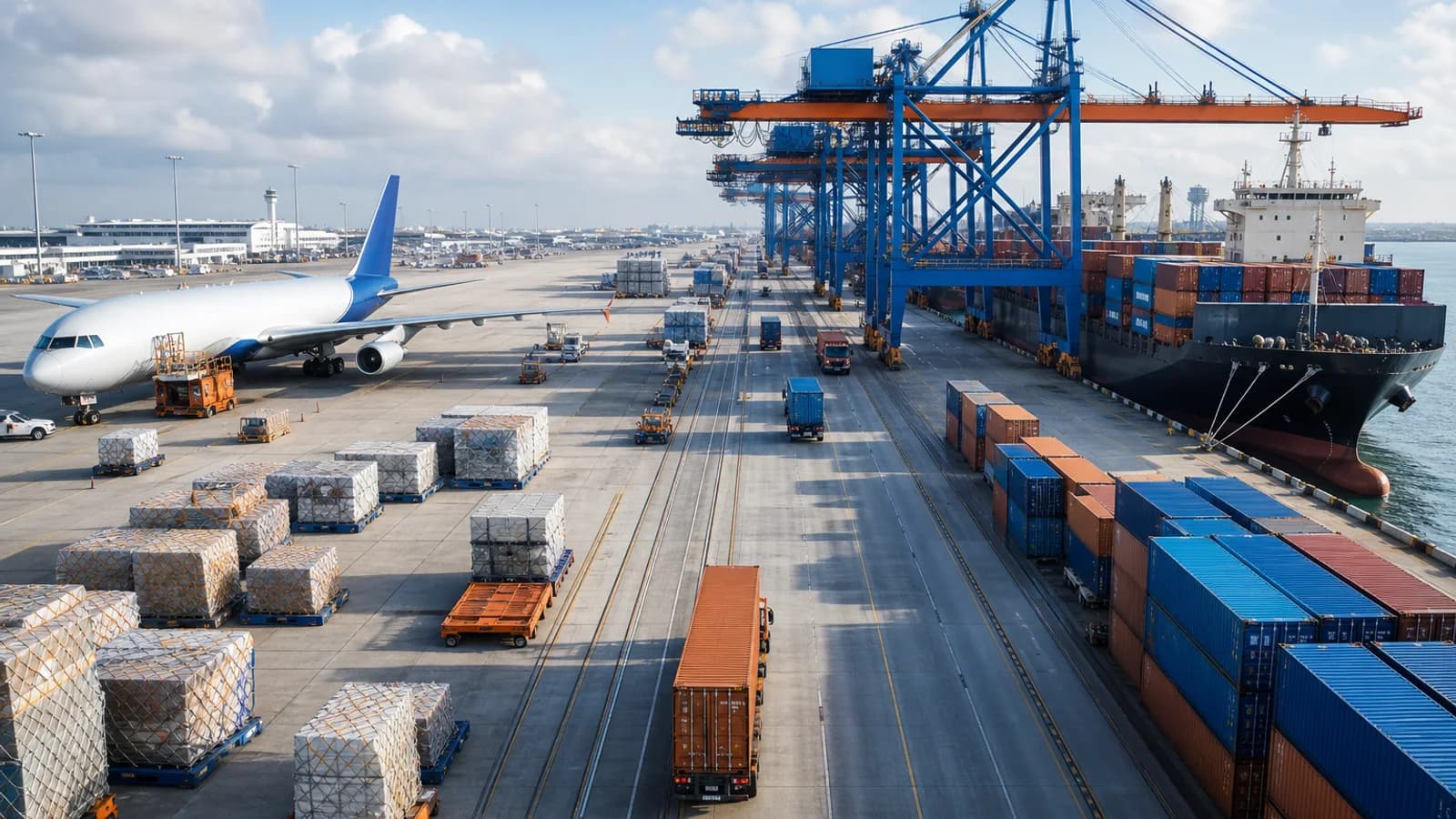
Direct answer
What should you do first?
Compare decisions at the inventory level. A split plan often moves the minimum stock required to protect revenue by air while the stable balance follows by ocean. For North American importers deciding how to protect a launch date or replenishment cycle, confirm the responsible party, evidence and decision cutoff before booking so the plan remains usable if the route, cargo or receiving instruction changes.
Key planning facts
- Best first decision
- Compare decisions at the inventory level. A split plan often moves the minimum stock required to protect revenue by air while the stable balance follows by ocean.
- Customs checkpoint
- Both modes require correct importer, classification, valuation and product compliance. A short flight does not compensate for missing entry data or agency documents.
- Cost checkpoint
- Air pricing is driven by chargeable weight and capacity; ocean cost depends on container use, consolidation, origin and destination charges, and final delivery. Compare the same delivery scope.
- Source basis
- 3 official sources checked 2026-07-24
Key takeaways
- Calculate air chargeable weight from actual dimensions before comparing a per-kilogram rate.
- Compare door-to-door time rather than flight time against port-to-port transit.
- Include inventory carrying cost, lost-sales exposure and production variability.
- Use stable carton dimensions to test whether packaging changes improve the air option.
- Set a decision cutoff so cargo does not miss both the intended flight and the preferred sailing.
Forest Leopard Operations reviews the shipment workflow against the official sources listed below. This page provides planning information, not legal, tax or product-compliance advice.
Read our editorial standardsWhat this guide helps you decide
Compare air and ocean freight using complete door-to-door time, chargeable weight, inventory risk and customs readiness. This guide is written for North American importers deciding how to protect a launch date or replenishment cycle. It is a planning framework, not a live rate sheet or a substitute for legal, tax, customs or product-compliance advice. Carrier schedules and government requirements can change, so the shipment should be checked against current official sources and the facts available on the booking date.
Compare decisions at the inventory level. A split plan often moves the minimum stock required to protect revenue by air while the stable balance follows by ocean. Start with the date on which inventory must be usable, not merely the date on which the international leg should arrive. Add supplier preparation, pickup, export cutoffs, terminal handling, customs release, inspection risk, appointment booking and final receiving. That complete timeline creates a meaningful comparison between modes and routes.
Build the shipment brief before asking for a rate
A useful quotation begins with consistent data. Provide the Chinese pickup address, final warehouse or marketplace code, commodity, intended use, declared value, HS classification if known, carton count, finished dimensions, gross weight, volume, Incoterm and cargo-ready date. State whether the goods contain batteries, liquids, powders, magnets, wood, branded products or oversized pieces. Missing characteristics can invalidate a route or price after the cargo reaches the warehouse.
Use the same brief when comparing forwarders. Ask each provider to identify the route, mode, cutoff, chargeable basis, importer assumption, customs scope, destination handling, final delivery and validity period. A number without those assumptions is not a comparable freight plan. For air vs ocean freight China North America, the quality of the input data matters as much as the apparent speed of the transport option.
- Origin pickup address and supplier contact
- Final country, city, postcode or FBA warehouse
- Commodity, value and intended use
- Carton count, dimensions, weight and volume
- Incoterm, ready date and required delivery date
- Restricted-goods and product-compliance flags
The five operating controls
Calculate air chargeable weight from actual dimensions before comparing a per-kilogram rate. This is planning control 1 for North American importers deciding how to protect a launch date or replenishment cycle. Record the owner, evidence and cutoff for this decision in the shipment file. When the underlying cargo, route or receiving instruction changes, reopen the decision instead of carrying an outdated assumption into booking.
Compare door-to-door time rather than flight time against port-to-port transit. This is planning control 2 for North American importers deciding how to protect a launch date or replenishment cycle. Record the owner, evidence and cutoff for this decision in the shipment file. When the underlying cargo, route or receiving instruction changes, reopen the decision instead of carrying an outdated assumption into booking.
Include inventory carrying cost, lost-sales exposure and production variability. This is planning control 3 for North American importers deciding how to protect a launch date or replenishment cycle. Record the owner, evidence and cutoff for this decision in the shipment file. When the underlying cargo, route or receiving instruction changes, reopen the decision instead of carrying an outdated assumption into booking.
Use stable carton dimensions to test whether packaging changes improve the air option. This is planning control 4 for North American importers deciding how to protect a launch date or replenishment cycle. Record the owner, evidence and cutoff for this decision in the shipment file. When the underlying cargo, route or receiving instruction changes, reopen the decision instead of carrying an outdated assumption into booking.
Set a decision cutoff so cargo does not miss both the intended flight and the preferred sailing. This is planning control 5 for North American importers deciding how to protect a launch date or replenishment cycle. Record the owner, evidence and cutoff for this decision in the shipment file. When the underlying cargo, route or receiving instruction changes, reopen the decision instead of carrying an outdated assumption into booking.
Mode, route and timeline
Compare complete movement windows. Ocean, air, rail and express labels describe the main transport leg, but inventory becomes useful only after origin handling, export, import and receiving are complete. A quoted flight time or sailing time should therefore be kept separate from the door-to-door planning range. Ask what event starts and stops every range and whether the range assumes immediate customs release and an available delivery appointment.
Capacity and schedules are not static. Peak seasons, weather, blank sailings, flight changes, terminal congestion and marketplace receiving limits can alter the plan. Agree on the last acceptable departure, the fallback route and the point at which a mode change becomes rational. This turns an urgent reaction into a controlled inventory decision and gives the supplier a clear cargo cutoff.
Customs, tax and compliance responsibilities
Both modes require correct importer, classification, valuation and product compliance. A short flight does not compensate for missing entry data or agency documents. The commercial invoice should describe the actual sale and goods. The packing list should reconcile to the physical cartons. Transport instructions should match the consignee and route. Product permits, conformity records or dangerous-goods documents must be available before the cutoff at which the carrier or authority needs them.
Do not use an Incoterm as a substitute for naming the importer or checking product eligibility. The term allocates specified delivery, cost and risk responsibilities between buyer and seller; customs and tax law decide who can make declarations and what records are required. Keep advice from the appointed broker, tax adviser and product specialist in the shipment file so later replenishments do not depend on memory.
Cost comparison and exceptions
Air pricing is driven by chargeable weight and capacity; ocean cost depends on container use, consolidation, origin and destination charges, and final delivery. Compare the same delivery scope. Ask how chargeable weight, minimum charges, exchange rates, fuel, security, seasonal surcharges and quote validity are handled. For container freight, confirm free time and the party responsible for empty return. For air and express, check dimensional weight and remote-area or oversize rules.
Also price the exceptions that matter to this shipment: inspection, customs exam, missing document, storage, demurrage, detention, failed delivery, relabeling, address change and return. These items cannot always be fixed in advance, but their ownership and charging method can be made clear. A more transparent plan may be commercially better than a lower initial figure with undefined destination exposure.
Control the shipment after booking
A booking confirmation is the start of execution, not the end of planning. Ask for the carrier or master reference, origin cutoff, planned departure, planned arrival and the next responsible party. Connect those milestones to the inventory decision described in this air vs ocean freight China North America guide. If the departure changes, update the expected customs and receiving dates immediately rather than repeating the old delivery estimate. A useful status explains what happened, when it happened, what evidence supports it and what must occur next.
Create an exception ladder before the cargo moves. The first level covers routine schedule changes that remain inside the inventory buffer. The second requires a route, mode or appointment decision. The third requires management attention because customs, compliance, cargo damage or a material deadline is at risk. Name the person who can approve extra cost at each level. For North American importers deciding how to protect a launch date or replenishment cycle, this discipline reduces slow email loops and keeps operational decisions connected to the commercial consequence of late or unusable inventory.
Close the file only after proof of delivery and cost reconciliation. Compare the final milestones with the original plan, record the cause of meaningful differences and update the next replenishment assumptions. Keep the customs entry, transport document, delivery evidence, supplier invoice and approved exception costs together. This history makes the next quotation more accurate and reveals whether packaging, supplier readiness, route choice or receiving instructions need to change.
Pre-booking control checklist
Before authorizing movement, hold a short shipment-file review. Confirm that supplier cargo data is final, the selected route is still available, the importer accepts its role, required source documents are present and the destination can receive the cargo. Date the review and record unresolved items with an owner and deadline. If a critical fact is missing, keep the booking provisional.
After booking, keep milestone updates tied to operational events: pickup completed, warehouse received, export cleared, departed, arrived, import entry accepted, customs released, delivery booked and proof of delivery received. An unexplained status such as in transit is less useful than a dated event with the next expected handoff.
- Calculate air chargeable weight from actual dimensions before comparing a per-kilogram rate.
- Compare door-to-door time rather than flight time against port-to-port transit.
- Include inventory carrying cost, lost-sales exposure and production variability.
- Use stable carton dimensions to test whether packaging changes improve the air option.
- Set a decision cutoff so cargo does not miss both the intended flight and the preferred sailing.
- Confirm official sources were checked on the date shown below.
- Confirm the quote names inclusions, exclusions and response owner.
- Keep the shipment reference in every email and document handoff.
Frequently asked questions
When is air freight worth the cost?+
When the value of earlier usable inventory exceeds the air premium and operational risk.
Is LCL always cheaper than air?+
No. Small dense shipments can produce destination minimums and handling that narrow the difference.
Can one order use both modes?+
Yes. A planned split is common when labels, documents and quantities can be controlled.
Official sources
Sources were last checked on 2026-07-24. Requirements and carrier practices can change; verify the current official page before booking.
Change log
- Initial operational review and official-source verification.